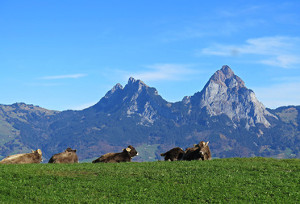


General: Cattle in the Alpine region
Description
For millennia, domestic cattle shaped the Alpine cultural landscape. In many regions of the Alps, they were the central livestock for dairy farming and thus the economic heart of mountain farming culture. As draft and pack animals, they ensured the cultivation of the Alpine valleys long before horses and later machines dominated agriculture.
Domestic cattle have been present in the Alpine region since the Neolithic period (around 5000 BC). Suitable grazing land was created through clearing of forests. Initially, meat production was the primary focus. Milk production was added only 1000 years later. Their use as draft and pack animals can be documented in the Alpine region from around 3500 BC. Cattle were particularly important as draft animals (oxen) but also as a source of manure for the increasing arable land. Because the animals were often kept in forest grazing systems during the Middle Ages, they were quite small (around 1 meter at the withers) due to the sparse diet. Even the three-field system of the High Middle Ages, in which cattle grazed on fallow and stubble fields with straw, leaves, or leaf hay, provided meager sustenance for domestic cattle. Livestock farming was secondary to arable farming during the High Middle Ages. It was only in the High Middle Ages that agricultural land use in the regions diverged into grain cultivation in the lower elevations and livestock farming in the middle and higher elevations of the Alps. Finally, in the modern era, the production of butter and cheese in the higher elevations became increasingly important.
Domestic cattle are useful to humans in many ways, with some breeds being specifically bred for one or more particular uses. A distinction is made between dual-purpose breeds and breeds focused on milk or meat production. Besides milk, meat, leather, and hides, cattle provide fertilizer in the form of slurry and manure, the latter also playing an important role as fuel and building material. Furthermore, oxen, in particular, still fulfill a vital function in many parts of the world as draft animals for carts and plowing. Robust breeds, adapted to their respective environments, are an important factor in landscape management and nature conservation (alpine farming).
Specialization in specific performance traits in cattle began in the 18th century when breeders selectively improved local breeds for particular traits by choosing high-quality parent animals. Around 1900, cows in lower-lying areas weighed about 250 kg with a withers' height of approximately 1.20 m and produced 1,500 to 2,000 liters of milk per year. Today, cattle have an average weight of 750 kg, a withers' height of 1.45 m, and a milk yield of approximately 6,000 liters per year. Traditional (local) breeds were widespread in the Alpine region. Exchanging breeding animals was hardly possible, especially in the difficult-to-access valleys. Therefore, various local strains were bred. Today, approximately 40 local breeds are still identified in the Alpine region.
General and History
Above the tree line, and also on other alpine meadows, a wonderful, colorful flora exists, which, however, is not natural but rather the result of centuries of mountain farming traditions. The hooves and mouths of the cows have shaped this flora.
While, for example, the Montafon Brown cattle breed was once the predominant breed in the Montafon region, it has been replaced by other, heavier breeds. While the Montafon Brown was a dual-purpose breed (milk and meat), most cattle are now either dairy or beef. The Montafon Brown cattle (in other regions, Allgäu Brown cattle, Grisons Grey cattle, and Tyrolean Grey cattle) were characterized by their frugality, resilience, and longevity. For instance, Daniel Mangeng's cow from Tschagguns had her 17th calf at the age of 19 (a Rhaetian Grey cattle breed in Grisons had its 19th calf at 23).
Literature
· Joachim Koller (2007). En allemand: Landwirtschaft in den Alpen - Alpwirtschaft
· Grünenfelder, H-P., Müller, N., Bussaglia, U., Dietrich, U., Dingwall, S., Dousse M., Prandino, R., Stumberger, B. Ruppen, S., Annen, J. (2003). En allemand: Landwirtschaftliche Genressourcen der Alpen ISBN 3-258-06669-8. Copyright © 2003 by Haupt Berne